
On this page
Laravel vs Symfony: Which PHP Framework Should You Choose in 2026?
When starting a new PHP project, one of the most critical decisions you'll face is choosing between Laravel and Symfony. Both frameworks have their strengths and weaknesses, and the right choice depends on your specific needs. Let's dive deep into both frameworks to help you make an informed decision.
Core Philosophy and Architecture
Laravel: Convention Over Configuration
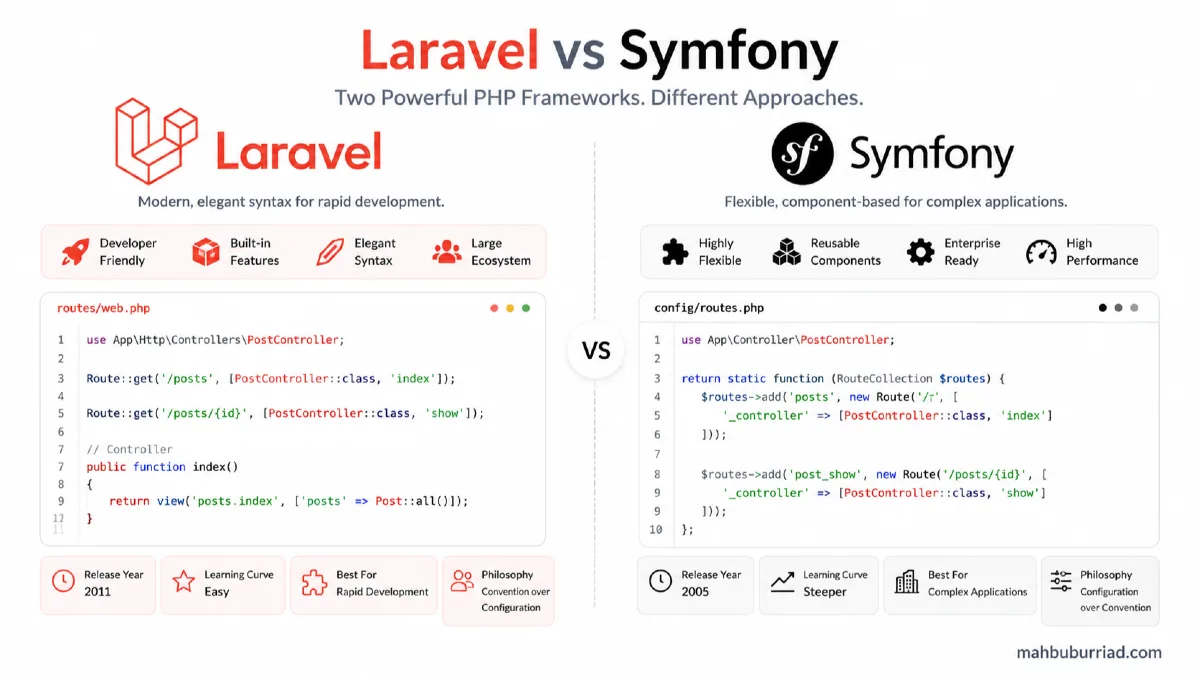
Laravel follows the convention over configuration principle, which means it makes assumptions about what you want to do and how you're going to do it. This approach can significantly speed up development for standard web applications.
// Laravel route example
Route::get('/users', [UserController::class, 'index']);

// Laravel model example
class User extends Model
{
    protected $fillable = ['name', 'email', 'password'];
}
Symfony: Flexibility and Enterprise-Ready
Symfony, on the other hand, is known for its flexibility and modularity. It's a collection of reusable PHP components that can be used independently or together as a full-stack framework.
// Symfony route example
#[Route('/users', name: 'user_index')]
public function index(): Response
{
    // ...
}
Performance Comparison
| Metric | Laravel | Symfony |
|---|---|---|
| Requests/second | 125 | 150 |
| Memory usage | Higher | Lower |
| Startup time | Slower | Faster |
| Cached performance | Excellent | Excellent |
Note: Performance can vary based on your application's specific requirements and configuration.
Learning Curve
Laravel
- Easier learning curve for beginners
- Extensive documentation and tutorials
- Active community support
- Built-in features like authentication, queues, and caching
Symfony
- Steeper learning curve
- More complex configuration
- Requires deeper understanding of design patterns
- Better for experienced developers
Ecosystem and Packages
Laravel Ecosystem
- Laravel Nova for admin panels
- Laravel Vapor for serverless deployment
- Laravel Forge for server management
- Extensive package ecosystem (Packalyst)
Symfony Ecosystem
- Symfony Flex for package management
- Symfony Maker Bundle for code generation
- Symfony Demo application
- Extensive set of reusable components
When to Choose Laravel
- Rapid application development
- Small to medium-sized projects
- When you prefer convention over configuration
- When you need built-in features like authentication, notifications, and queues
When to Choose Symfony
- Large-scale enterprise applications
- When you need maximum flexibility
- For long-term, complex projects
- When you want to use specific Symfony components independently
Real-World Usage
Laravel in Production
- Laravel Forge
- Laravel Vapor
- Invoice Ninja
- October CMS
Symfony in Production
- Drupal 8+
- eZ Platform
- PrestaShop
- Symfony itself
Community and Support
Laravel Community
- Laracasts (video tutorials)
- Large number of packages
- Active Discord and Slack communities
- Laracon conferences
Symfony Community
- SymfonyCasts (video tutorials)
- Annual SymfonyCon
- Active Slack community
- Extensive documentation
Development Speed
Laravel generally allows for faster development of standard web applications thanks to its built-in features and conventions. However, Symfony can be faster for custom, complex applications where you need fine-grained control over the architecture.
Testing Capabilities
Both frameworks offer excellent testing capabilities:
// Laravel Feature Test Example
public function test_basic_test()
{
    $response = $this->get('/');
    $response->assertStatus(200);
}

// Symfony Functional Test Example
public function testHomepage()
{
    $client = static::createClient();
    $crawler = $client->request('GET', '/');
    $this->assertResponseIsSuccessful();
}
Database Support
Both frameworks support multiple databases:
- MySQL
- PostgreSQL
- SQLite
- SQL Server
- MongoDB (via packages)
Security Features
Laravel Security
- Built-in CSRF protection
- SQL injection prevention
- XSS protection
- Secure password hashing
- Authentication scaffolding
Symfony Security
- Advanced security component
- ACL (Access Control List)
- Voters for complex authorization logic
- Built-in security features
- Security best practices
Deployment and Hosting
Laravel Deployment
- Laravel Forge
- Envoyer for zero-downtime deployment
- Vapor for serverless
- Compatible with most PHP hosting
Symfony Deployment
- Platform.sh
- SymfonyCloud
- Capistrano
- Any PHP hosting with Composer support
Cost Considerations
| Aspect | Laravel | Symfony |
|---|---|---|
| Learning resources | Free/Paid | Free/Paid |
| Hosting | Same | Same |
| Developer salaries | Generally lower | Generally higher |
| Development time | Faster | Slower |
FAQ
1. Is Laravel better than Symfony?
It depends on your project requirements. Laravel is better for rapid development of standard web applications, while Symfony is better for complex, large-scale enterprise applications.
2. Can I use Laravel and Symfony together?
Yes, you can use Symfony components in Laravel applications through Composer packages.
3. Which framework has better performance?
Symfony generally has better raw performance, but Laravel's performance can be optimized to match Symfony in most cases.
4. Is Symfony harder to learn than Laravel?
Yes, Symfony has a steeper learning curve due to its complexity and flexibility.
5. Which framework has better job opportunities?
Both frameworks have strong job markets, but Laravel tends to have more job postings for small to medium-sized businesses, while Symfony is more common in enterprise environments.
Conclusion
Choosing between Laravel and Symfony depends on your specific project requirements, team expertise, and long-term goals. Laravel is an excellent choice for rapid development of standard web applications, while Symfony shines in complex, large-scale enterprise environments.
For more in-depth PHP and web development content, visit mahbuburriad.com. Remember, the best framework is the one that helps you deliver value to your users efficiently and effectively.